Sleep sound, simply explained
White Noise for Sleep: What It Does, and How to Use It Well
If you wake up every time a car door slams or your partner rolls over, the problem usually isn't that your bedroom is too loud. It's that it's too quiet in between. Here's what steady background sound actually does, and how to use it without overdoing it.
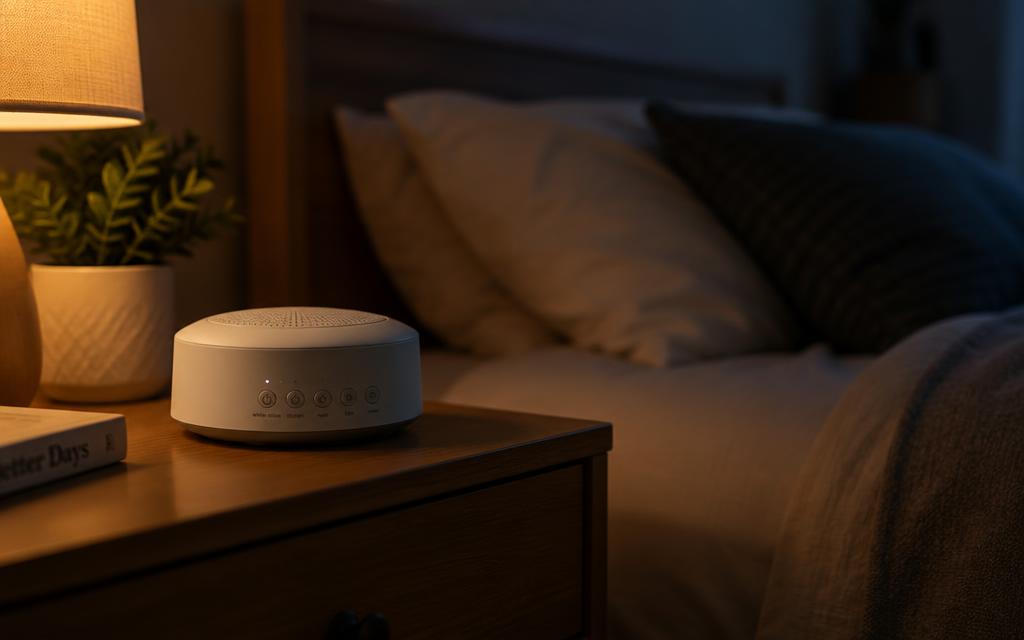
It's about contrast, not volume
What wakes you at 3am is rarely a loud sound in isolation — it's a sound that stands out sharply against near-silence. A steady, featureless background sound narrows that gap, so a passing motorbike becomes part of the wash instead of a spike. That's called masking, and it's the one thing every sound machine genuinely does well.
This also explains when it won't help much: a quiet room with no interruptions has nothing to mask. If your trouble is falling asleep with a busy mind rather than noise, a sound machine is the wrong tool.
White, pink or brown?
White noise
Even across all frequencies. Bright, hissy — like untuned static. Strong masking for higher-pitched noise.
Pink noise
More energy low down. Softer, like steady rain. The most widely liked for sleeping.
Brown noise
Deeper still — a low rumble. Good against traffic and bass from neighbours.
There's no winner here. Try each for a few nights and keep the one that fades into the background fastest for you.
Setting it up well
- Keep the volume modest. Turn it up only until intruding sounds stop standing out. Louder doesn't mask better once the contrast is gone.
- Place it between you and the noise. Near the door or the shared wall works better than right beside your head.
- Leave it on all night. A timer that shuts off at 1am leaves the quietest, most wake-prone hours unprotected.
- Keep it well away from a baby's crib. For nurseries, use a low volume and distance rather than a machine right at the cot rail.
- Watch the loop. If you can hear a sample repeating, switch sounds or choose a fan-based machine.
What to look for when buying
Four things matter far more than the number of sounds on the box: a natural tone you can stand for eight hours, fine volume control at the low end, no audible looping, and the option to run continuously without an auto-shutoff. Travel size, a headphone jack, and app control are nice extras — not reasons to choose one machine over another.
Common questions
What is the difference between white, pink and brown noise?
They describe how sound energy is spread across frequencies. White noise has equal energy at every frequency and sounds bright, like static. Pink noise puts more energy in lower frequencies and sounds softer, like steady rain. Brown noise leans even further into the low end and sounds like a deep rumble or distant waterfall. None is objectively best — pick whichever your ears find least annoying, because that's the one you'll keep using.
Does white noise actually help you sleep?
Its main job is masking: a steady background sound reduces the contrast between silence and sudden noises like traffic, a door, or a snoring partner, so those sounds are less likely to jolt you awake. That's why it tends to help most in noisy environments. Evidence for improving sleep in an already quiet room is much weaker, so treat it as a tool for noise problems rather than a cure for poor sleep.
How loud should a sound machine be?
Only as loud as it needs to be to blur background noise — a conversational level or below is plenty for most bedrooms. Louder is not better, and prolonged high volume is worth avoiding, especially close to a baby's crib. Start low, and raise it only if noises still wake you.
Fan-based or electronic sound machine?
Fan-based machines like the Yogasleep Dohm create real moving air inside a housing, which many people find more natural and less repetitive. Electronic machines play digital sounds, usually with more options, timers, volume memory and often a headphone or app option. Fan-based wins on natural tone; electronic wins on flexibility and travel size.
Is looping a problem?
It can be. Cheaper electronic machines use short samples that repeat, and once you notice the loop it's hard to un-notice. Machines advertising non-looping or long-sample playback avoid this, and fan-based machines have no loop at all.
Where to go next
If masking sound is what you need, our shortlist covers fan-based and electronic machines with honest pros and cons. And if mornings are the harder half of the problem, the free alarm clock on our homepage costs nothing to try tonight.